Why We Went to the House of Lords

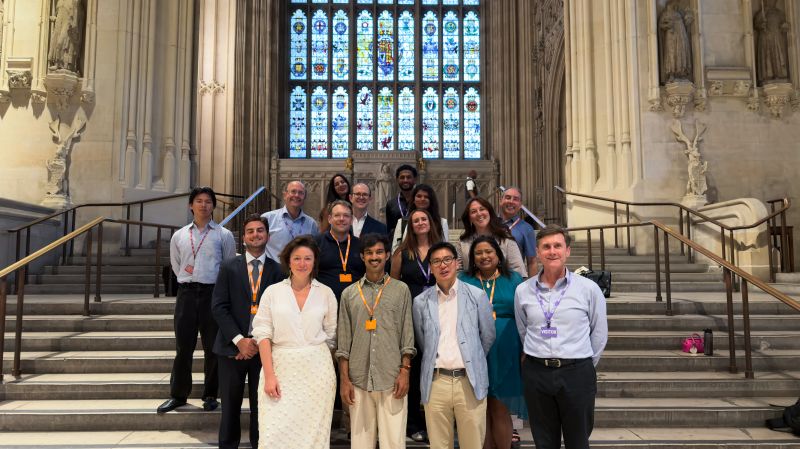
There is a question underneath all the debate about AI and the legal profession that rarely gets asked directly. Not what tools lawyers will use, or how many training contracts will exist in five years, but what law is actually for. On 7 July, we tried to ask it in the right room.
Not a conference
The evening at the House of Lords was not a conference. There was no main stage, no sponsor booths, no panel of people who broadly agreed with each other and said so politely. It was an invitation-only gathering at Westminster, hosted by Lord Wei of Shoreditch and supported by Maker Life, with around 150 people who had serious skin in the question: general counsel, law students, legal technologists, policymakers, and a handful of people who had recently left law firms to build something different.
We ran it because we think the conversation about law and AI is stuck. It is mostly about lawyers, when it should be about legal systems. It is mostly about the next two years, when the decisions that matter are being made over the next ten. And it is mostly fear-shaped, when the honest answer is that there has never been a more interesting time to be building in and around the law.
Lord Wei's riddle
Lord Wei opened with a riddle. Cecil is a criminal lawyer. Many years ago he spent a couple of days in hospital, was in perfect health when he left, but was incapable of leaving his bed on his own and had to be carried. Why?
Cecil was a baby.
The riddle is about assumptions. We bring context to every situation we encounter, and most of the time that context helps. In the case of AI, Lord Wei argued, the assumptions we carry from how law has always worked are the biggest obstacle to seeing what it could become. The mindset question is not about whether to adopt AI. It is about whether we are capable of seeing the profession differently at all.
He also raised something that has stayed with me. The UK produces roughly 100,000 law graduates a year. Historically there have been around 20,000 training contracts. AI will not reduce that gap. If anything, it will widen it. The question of what we do with 80,000 to 90,000 people a year who have a legal education and nowhere obvious to take it is not a professional problem. It is a structural one. That framing is part of why we built what we are building.
What Richard Susskind argued
Richard Susskind, who has spent 45 years advising on the future of legal services and serves as technology adviser to the Lord Chief Justice, opened with a story about Black and Decker. The company does not sell drills. It sells holes. His argument was that the profession has spent decades thinking about how to improve the current process rather than asking what clients actually need. AI is forcing that question into the open in a way that cannot be deferred.
He outlined six hypotheses about where AI is heading, from the hype hypothesis (the bubble will burst, the technology is overstated) through to AGI, superintelligence, and what he called the AI evolution hypothesis, held by some physicists, that humanity's contribution to the cosmos may simply be to develop intelligences that replace us. He was direct: building strategy only on the most conservative of these hypotheses is a dereliction of duty for anyone in a leadership role.
His practical read is that by the early 2030s, AI systems will operate without routine human supervision across most tasks, and that policymakers and institutions should be planning for AGI arriving between 2030 and 2035. Not as a certainty. As a possibility significant enough to demand serious preparation. In the short term, he said, AI in law means AI for lawyers. In the long term it means something different: using the technology to reach the people who currently cannot access legal help at all.
Where I think the transition is actually happening
I talked about what we are seeing at GenieAI across the more than 200,000 businesses we work with.
The practical shift right now is from people using AI to people running ambient agents that work continuously in the background. I currently have around 50 agents running across different tasks. The legal application of this is specific: it requires encoding your organisation's rules, positions, and standards into something an agent can actually follow. Department by department, that is what we see clients building. The lawyer's job stops being to produce every document and starts being to underwrite the workflows that produce them. That is a bigger role, not a smaller one.
The roles we think are emerging from this are not abstract. Trust Associates configure the AI workflows and build the contract playbooks that make a legal team scalable. Trust Advisors work at the intersection of law, technology, and business, the credible human face of governance. Trust Architects design the frameworks that make AI in legal settings safe to rely on at scale. Those are the tracks we have built the Future Lawyer Fellowship around.
What the panel said about trust
The panel surfaced things the earlier discussion had not. Patricia Shaw, CEO of Beyond Reach and one of the most influential voices in UK tech ethics and governance, cited the ISO definition of trust as the ability to meet stakeholder expectations in a verifiable way, and argued that unless you design for that outcome from the start, accuracy and safety will always be defined too late. Andrew Wingfield, who spent two decades in commercial contracting and now leads innovation at Farringford Legal, observed that in practice, clients rarely asked whether a contract was accurate. They asked whether they could trust the advice. Dr Abigail Gilbert from the Institute for the Future of Work brought research showing that firms running regular retrospectives on AI decisions found their people thinking more critically than before, not less.
All three independently ranked trust as the hardest of the three problems to solve, ahead of accuracy and safety. That convergence was unplanned. It meant something.
One question from the floor that I keep thinking about came from a former Slaughter and May lawyer who had recently joined GenieAI as a legal engineer. He asked whether AI would make the practice of law more fun. Andrew's answer was the best of the night. He said he had embraced the changes years ago, and that there was something in law becoming more like a beautiful game.
What we are building next
The event was partly designed to help shape what comes next for people who want to build in and around law rather than wait and see. That conversation is where the Future Lawyer Fellowship came from.
It is an 8-week pilot, built by GenieAI and supported by Maker Life, for early-career lawyers, law students, career returners, and anyone serious about the intersection of law and technology. Graduates move into roles, found ventures, or join the consulting Guild. The goal is not to produce more junior lawyers doing what junior lawyers currently do. It is to produce a generation of people who can build the legal infrastructure that the next decade actually needs.
If the evening at Westminster raised questions for you, the fellowship is where we are working on answers. You can register your interest at genieai.co/the-future-lawyer-fellowship.
A former bond and derivatives trader who managed a £1bn portfolio at an investment bank - he left finance to pursue an MSc in Machine Learning taught by Google DeepMind - where he met co-founder Nitish and set out to fix the legal industry.


.png)