
The Vagueness Problem: What AI Review Reveals About UK Business Contracts
An analysis of 365,360 contracts from 244,337 organisations, including 66,234 from 32,448 UK businesses. The most common problem AI finds in a business contract is not money or liability. It is imprecision.
Five things we learned from UK contract review.
The most common contract problem is imprecision, not money.
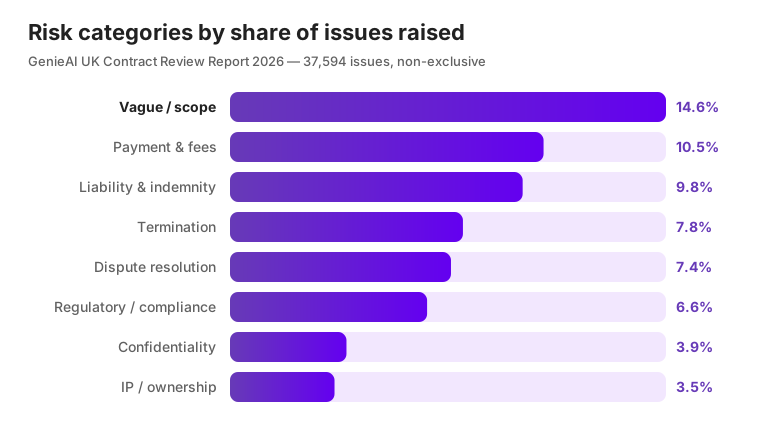
Vague or ambiguous wording is the most common issue in UK business contracts, at 14.6% of all issues raised, ahead of payment terms (10.5%) and liability (9.8%) - and the #1 category in every quarter measured.
GenieAI UK Contract Review Report 2026. n = 37,594 issues, 3,692 contracts.
| Risk category | Share of issues |
|---|---|
| Vague / scope | 14.6% |
| Payment & fees | 10.5% |
| Liability & indemnity | 9.8% |
| Termination | 7.8% |
| Dispute resolution | 7.4% |
| Regulatory / compliance | 6.6% |
| Confidentiality | 3.9% |
| IP / ownership | 3.5% |
The instinct is to fight hardest over money and liability, because those feel like the dangerous clauses. The more common problem is quieter: a scope left vague, a deliverable never pinned down, an obligation written loosely enough that two sides can read it two ways. Those are the terms that look harmless on the day you sign and become the dispute eighteen months later. Precision is not pedantry. It is the cheapest insurance a business can buy.
Imad Mohammed Nazar, Report reviewer, GenieAI (draft for sign-off)Most contracts carry more than one problem, and UK contracts more than most.
GenieAI flagged at least one risk issue in 77% of UK contracts reviewed, versus 57% globally, a 20-percentage-point gap.
GenieAI UK Contract Review Report 2026.
Contracts flagged for vague wording carry 43% more risk issues overall (11.2 versus 7.8 on average) than clear ones.
GenieAI UK Contract Review Report 2026.
| Clause type | Share of clause actions |
|---|---|
| Payment & fees | 19.8% |
| Termination / expiry | 14.6% |
| Liability & indemnity | 10.8% |
| Dispute resolution | 9.7% |
| Confidentiality | 8.3% |
Almost every contract we looked at had something worth questioning, and the typical one had nine separate points. The practical lesson is to check the unglamorous clauses: payment triggers, termination rights, what happens to your data and who owns the work. That is where the value and the risk actually sit.
Swetha Meenal, Report reviewer, GenieAI (draft for sign-off)AI review is no longer the bottleneck.
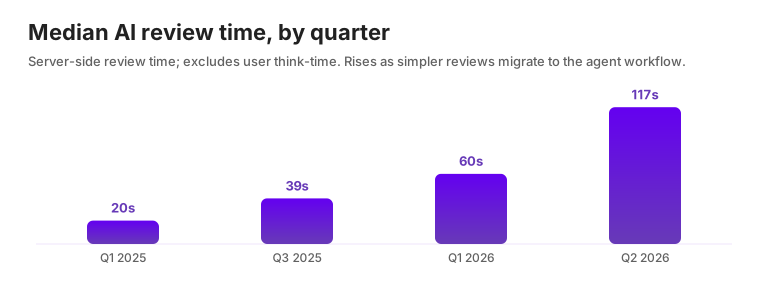
GenieAI reviews a full contract, clause by clause, in a median of around two minutes, with 95% complete within five minutes.
GenieAI UK Contract Review Report 2026, most recent complete quarter.
| Quarter | Median AI review time |
|---|---|
| Q1 2025 | 20s |
| Q3 2025 | 39s |
| Q1 2026 | 60s |
| Q2 2026 | 117s |
For decades the bottleneck in contracting was reading time. That constraint is gone. When a contract can be reviewed in minutes, the question is no longer whether you can afford to check every agreement, it is why you would not. The delay in getting deals done is not the analysis any more. It is the process and the negotiation around it, and that is the next thing to fix.
Rafie Faruq, Co-Founder and CEO, GenieAI (draft for sign-off)A historical view of negotiation behaviour on the platform.
Across 37,428 clause-level negotiation decisions recorded by GenieAI, 78% resolved as agreement, roughly five times the rate of outright rejection.
GenieAI UK Contract Review Report 2026.
UK contracts negotiated more intensely than the global average: the 90th-percentile UK contract saw five rounds of clause-level negotiation versus four globally.
UK n = 2,249; global n = 10,682.
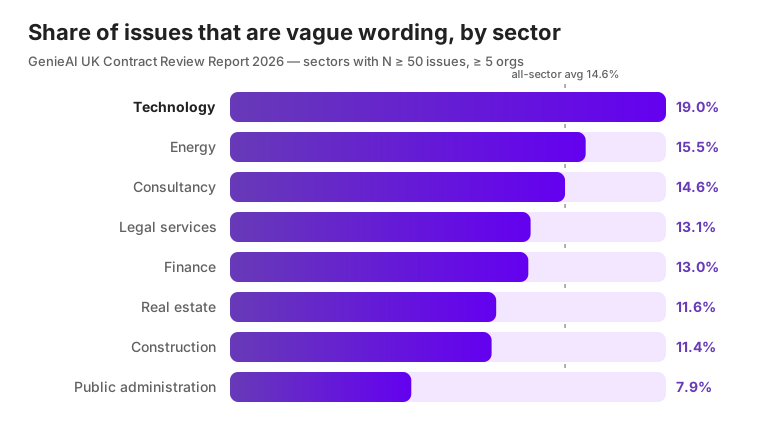
Which sectors have the vaguest contracts.
| Sector | Vague-wording share |
|---|---|
| Technology | 19.0% |
| Energy | 15.5% |
| Consultancy | 14.6% |
| Legal services | 13.1% |
| Finance | 13.0% |
| Real estate | 11.6% |
| Construction | 11.4% |
| Public administration | 7.9% |
External data referenced in this report.
Sources
- Contracting: the overlooked source of procurement value (11% value erosion) · World Commerce & Contracting, 2026
- Critical decline in business contract effectiveness (39% achieve goals; down 40% since 2017) · World Commerce & Contracting / Deloitte, 2024
- Inefficiency in contract management (30+ hours to negotiate; 3-4 versions) · Docusign, 2019
- AI set to save professionals 12 hours per week by 2029 · Thomson Reuters, 2024
- UK legal services deliver record economic contribution (38bn GBP, 2024) · TheCityUK / The Law Society, 2024
- Business population estimates for the UK, 2024 (5.5m businesses, 99.9% SMEs) · ONS / Dept for Business & Trade, 2024
- Regulated population statistics (177,841 practising solicitors) · Solicitors Regulation Authority, 2026
About this data
Figures are aggregated, anonymised telemetry from contracts reviewed on the GenieAI platform. No contract text, personal data or customer-identifiable information is included; all figures are aggregates. The UK cohort is identified by the organisation's registered country. We report only on contracts reviewed on GenieAI and make no claim to represent all UK contracts. Risk and clause categories are derived by keyword classification of AI-generated issue titles and worked-paragraph text and are non-exclusive. AI review time is measured server-side and is analysis time, not end-to-end time to signature; GenieAI does not record signing. Review-time medians are reported for the most recent complete quarter, since usage has shifted between workflows over time.
| Sample | 365,360 contracts from 244,337 organisations (UK cohort: 66,234 contracts from 32,448 organisations). Risk categories from 37,594 issues across 3,692 contracts. |
| Period | 2020-06 to 2026-07; headline current-state metrics from the most recent complete quarter. |
| Data as at | July 2026 |
- No figure is reported for any group below 50 observations (30 for supporting cuts) or fewer than 5 distinct organisations, to prevent any single customer influencing a published number.
- All figures read from a single database snapshot on 15 July 2026.
Use these figures
You’re welcome to reproduce these statistics and charts with attribution and a link to this page.
GenieAI (2026). The UK Contract Review Report. https://www.genieai.co/research/uk-contract-review-report-2026 Get the full data and charts
Download the underlying data tables (CSV), an embeddable chart pack, and the PDF edition with an enterprise appendix.